
Understanding Disenfranchisement Behind Bars as a Legacy of Slavery
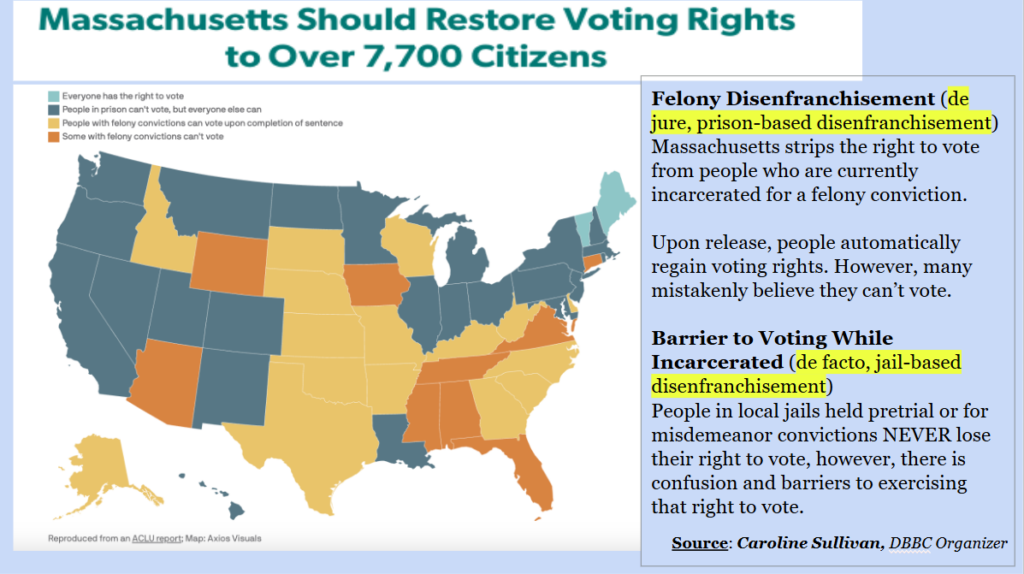
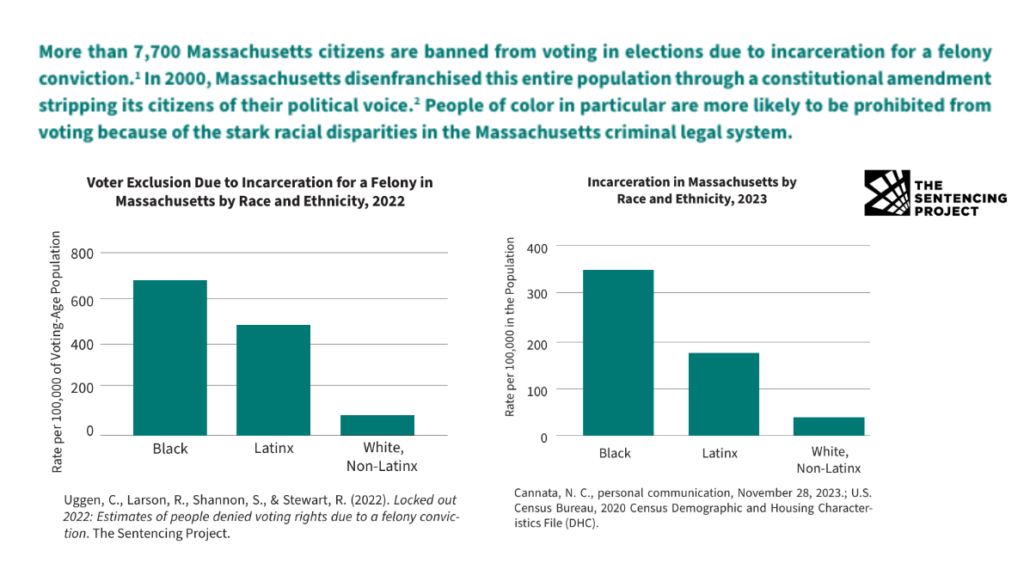
Jail-Based Disenfranchisement in Massachusetts is a 21st century human rights issue. Massachusetts remains an outlier in New England when it comes to voting rights for incarcerated individuals. Since a constitutional amendment passed in 2000, people serving a felony sentence in prison have been stripped of their right to vote—a reversal of more than two centuries of inclusive voting rights in the state. Today, over 7,700 citizens are disenfranchised under this law. The impact falls disproportionately on Black and Latinx communities: although Black residents make up less than 7% of the state’s population, they account for 31% of the prison population; Latinx residents represent 13% of the population but nearly 29% of those incarcerated. These disparities extend racial injustice from the criminal legal system into the electoral system, eroding political power in descendant communities and weakening democratic participation.
While voting rights are restored upon release, confusion and misinformation often prevent formerly incarcerated individuals from exercising those rights. For those held in pretrial detention or serving misdemeanor sentences—people who remain eligible to vote—the barriers to casting a ballot from jail have historically been immense. Massachusetts addressed this gap in 2022 by passing the VOTES Act, which introduced jail-based voting protections. Still, the culture of disenfranchisement persists, and urgent needs remain: clear civic education, infrastructure for jail-based voting, and legislative advocacy to restore voting rights for all incarcerated individuals.
Source: Jollie, Rachel, and Kristen M. Budd. Massachusetts Should Restore Voting Rights to Over 7,700 Citizens. Washington, DC: The Sentencing Project, February 2024.
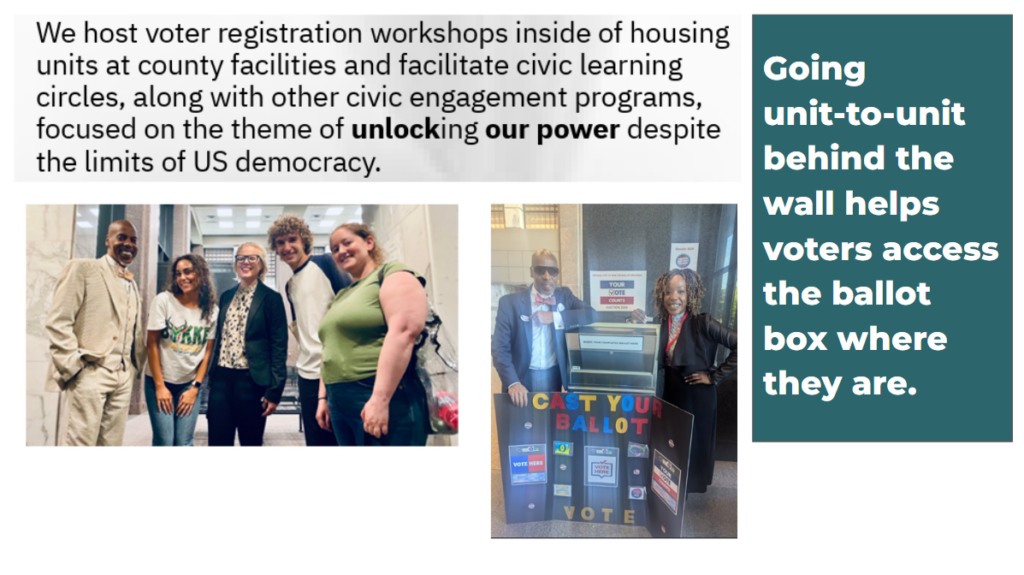
The Empowering Descendant Communities (EDC) project protects voting rights in jails and advances the fight to restore voting rights in prisons by combining civic education, direct organizing, and policy advocacy led by incarcerated and formerly incarcerated people themselves. Inside Suffolk County facilities, EDC volunteers and Jail‑Based Voting Ambassadors run Reflection Circles, distribute voter guides, help residents register and apply for absentee ballots, and document barriers that illegally prevent eligible voters from casting ballots.
The coalition also challenges systemic failures—such as the inability to determine voter eligibility, lack of language access, denial of volunteer status to formerly incarcerated educators, and the absence of clear statewide policies (“existing technological infrastructure does not automatically identify eligible voters…”; “no policies exist to date regarding community involvement in Jail‑Based Voting implementation”).
At the statewide level, EDC works with the AACC (African American Coalition Committee), DBBC (Democracy Behind Bars Coalition), and HOLI to push for universal voting rights restoration, gather signatures for a ballot initiative, and demand data transparency and legislative reform. Together, these efforts build a movement to ensure that democracy does not stop at the jail or prison door.
Featured Exhibits on Civic Power
Reflection Circles for Reimagining Democracy are designed to empower incarcerated leaders as civic educators and storytellers. Through these circles, Jail-Based Voting (JBV) Ambassadors and volunteers cultivate spaces of learning, resilience, and collective action. The program’s central objective is to dismantle disenfranchisement and restore voting rights for incarcerated citizens in Massachusetts, while also building civic literacy and resilience among participants. By connecting personal testimonies to social justice movements, Reflection Circles transform silence into action and foster intergenerational civic engagement that reaches families and communities beyond the walls.
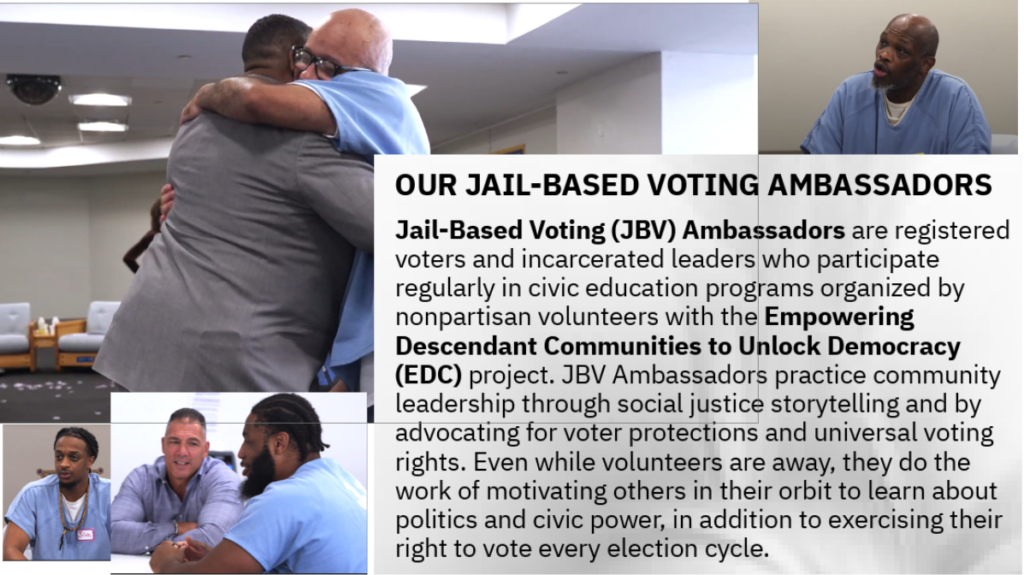
Reflection Circles for Reimagining Democracy has engaged a participant base of 330 Jail-Based Voting (JBV) Ambassadors across multiple facilities in Massachusetts. These Ambassadors represent diverse units and buildings at Nashua Street Jail and The Suffolk County House of Corrections (Buildings 1, 3, and 8), with regular Reflection Circles scheduled on weekday mornings and evenings.
A zine is a small, self‑published booklet that people create to share their own stories, analysis, and calls to action outside traditional publishing. Zines are meant to be handmade, accessible, and community‑driven—tools for political education, creative expression, and collective empowerment.
The Reimagining Democracy zine created by the Jail‑Based Voting Ambassadors grew out of Reflection Circles inside Suffolk County facilities. As the attached document shows, ambassadors use circle space to study civics, write about their lived experiences, and strategize about dismantling disenfranchisement (“Circle is where we make sense of complex realities in US democracy…”). They created this zine to amplify their voices, document the barriers they face, and share stories of resilience, political insight, and liberation (“Our Zine…is a self-made booklet of real stories and calls to action centered on the theme of Storytelling for Social Justice.”). It exists to challenge the idea that “we don’t do democracy here,” and to show how incarcerated leaders are building civic power, educating their peers, and imagining a more inclusive democracy from behind the wall.
Unlocking Democracy through Jail-Based Advocacy

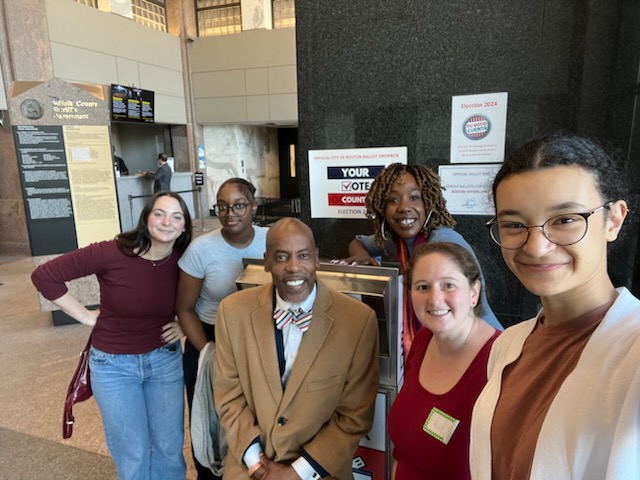
The Unlocking Our Power Jail‑Based Voting Ambassadors Forums at South Bay in 2024 and 2025 were milestone events in Boston’s jail‑based civic engagement work, each expanding who could participate and how widely voices could be heard.
2024 Forum (Men’s Units Only)
The first forum brought together Jail‑Based Voting (JBV) Ambassadors from the men’s units at South Bay to share speeches on civic engagement, jury duty, jail conditions, community safety, and reentry. Ambassadors presented to outside guests, jail leadership, and community partners, followed by small‑group circles and in‑unit voter registration workshops. This inaugural event established a model for centering the political knowledge, lived experience, and leadership of incarcerated residents.
2025 Forum (Expanded to Women, Trans Ambassadors, and Nashua Street)
The second forum grew significantly in size and scope. It included women ambassadors, trans and nonbinary ambassadors, and participants from Nashua Street Jail who joined via Zoom, creating a multi‑site, multi‑unit gathering. The program featured grounding rituals, two rounds of ambassador speeches, commentary from former Suffolk County DA Rachael Rollins, State Representative Russell Holmes, and Gubanatorial Candidate Andrea James. The day concluded with voter‑registration workshops across both men’s and women’s units. This expanded forum reflected a deeper commitment to inclusion, accessibility, and cross‑facility civic empowerment.
TAKE ACTION TO EXPAND DEMOCRACY BEHIND BARS
What step can you take today to support jail‑based voting and the statewide movement to restore voting rights for people serving felony convictions?
Ways to support the Voting Rights Movement in Massachusetts:
Advocating for universal voting rights restoration so that people serving felony sentences can fully participate in civic life.
Supporting jail‑based voting programs by volunteering with voter registration drives, educational workshops, or ballot access efforts.
Sharing information about voting rights for incarcerated residents to counter misinformation and expand public understanding.
Partnering with community organizations working on civic empowerment inside jails and prisons to strengthen statewide coalitions.
Contacting your state legislators to express support for policies that protect and expand voting access for people impacted by the criminal legal system.