
A Digital Resource on Public Safety, Food Justice, & Civic Power in Boston, Massachusetts from the 1960s to the Present
Who We Are
The Building Beloved Communities (BBC) project is a partnership between The Ohio State University, Roxbury Community College, and Healing Our Land, Inc. We bring together OSU students and faculty, RCC librarians and community scholars, and HOLI’s faith‑rooted organizers to lift up the knowledge, history, and leadership already present in Boston’s neighborhoods. Our work centers the lived experiences of people impacted by incarceration, food insecurity, and community violence, and it connects academic learning with real community needs.
What We Do
We collect and share stories—through digital archives, oral histories, and easy‑to‑use learning tools—that highlight how Boston residents care for one another, organize for change, and build safer, healthier communities. OSU students enrolled in Public History for Prison Abolition and Citizens Behind Bars help research, curate, and design these materials as part of their coursework. RCC students and community scholars contribute local knowledge, while HOLI organizers bring decades of experience working with families, returning citizens, and faith communities.
Together, we create resources that are grounded in everyday life, easy to understand, and useful for teaching and community conversations.
How This Resource Supports Local Programs
Healing Our Land and Roxbury Community College will use these digital stories and teaching tools to strengthen ongoing programming in Suffolk County Jails and Department of Youth Services (DYS) facilities. These materials will help:
support civic education, civic engagement, and civic leadership workshops for Jail‑Based Voting Ambassadors
enrich reentry and healing justice-centered programs led by HOLI and the Democracy Behind Bars Coalition
provides instructors with The FORT program at RCC with accessible, community‑rooted content for classes taught inside jails and youth facilities
give incarcerated and system-impacted leaders opportunities to see their own experiences reflected in history and public life and contribute to a living resource that documents ongoing efforts to improve community life and well-being in Boston and beyond
Why This Resource Matters
Since the onset of nationwide uprisings against police brutality in 2020, the American public has grown increasingly aware of how problems in policing reflect broader social harms, economic injustices, and political obstacles that ultimately lead to traumatic violence and premature death, especially for the most marginalized people among us.
People inside jails and youth facilities are often cut off from the histories, leaders, and community knowledge that could help them feel connected, informed, and powerful. By creating resources that come directly from Boston communities—and by involving OSU and RCC students in the process—we help make sure these stories are preserved, shared, and used to support learning, healing, and civic engagement. This work strengthens community ties and helps build a future where everyone has a voice in shaping safer and more just neighborhoods.
Three Pillars & Research Questions
Each research question ties directly to BBC’s three pillars—public safety, food justice, and civic power—by asking how everyday people in Greater Boston have shaped, experienced, and been impacted by systems of violence, inequality, and community care since the 1960s.
Public Safety — how communities create safety beyond the criminal legal system
Public safety refers to the conditions that allow people to feel safe, supported, and free from harm in their neighborhoods—through strong relationships, stable housing, youth programs, violence prevention efforts, and community leadership, not just law enforcement.
Research Question: How have residents most affected by deadly violence in Greater Boston shaped public safety through community advocacy and activism since the 1960s?
This question examines how Black, Latinx, and immigrant communities have responded to violence by building their own safety strategies—organizing neighborhood patrols, youth programs, trauma support networks, and campaigns for accountability. It shows that public safety has always been shaped from the ground up.
Food Justice — how access to food reflects safety, stability, and inequality
Food justice means that every neighborhood has reliable access to affordable, healthy food—grocery stores, farmers markets, community gardens—and that residents have the power to shape their local food systems.
Research Question: How has deadly violence impacted food security, such as the availability of grocery stores and farmers markets, across Greater Boston neighborhoods?
This question explores how violence, disinvestment, and racial segregation have shaped where food resources are located. It connects deadly violence to the closing of grocery stores, the rise of food deserts, and the uneven distribution of farmers markets—showing that food access is a public safety issue.
Civic Power — how everyday people participate in political decisions that shape their lives and communities
Civic power refers to the ability of residents to influence decisions about policing, housing, schools, voting, and neighborhood resources. It includes voting, community organizing, public meetings, and leadership roles.
Research Question: How has policing and incarceration in Greater Boston neighborhoods affected civic power and civic engagement for residents directly involved in the criminal legal system?
This question examines how policing practices, incarceration, and reentry shape people’s ability to vote, attend meetings, advocate for change, or feel safe participating in civic life. It highlights how the criminal legal system can weaken civic power—and how communities work to rebuild it.
Preliminary Findings & Data Maps
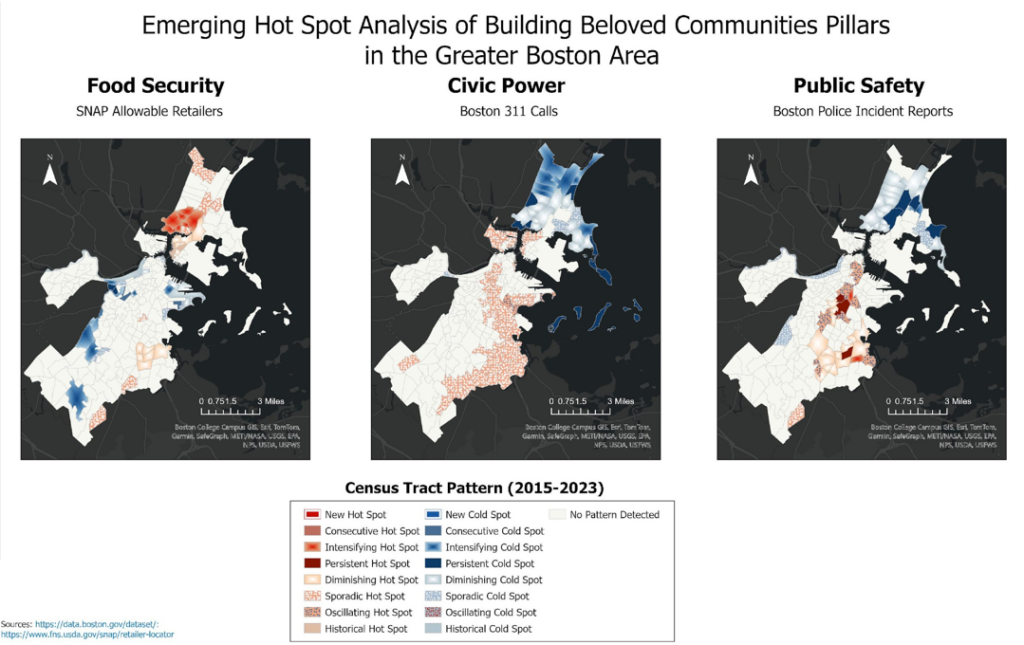
updated maps and data descriptions coming soon
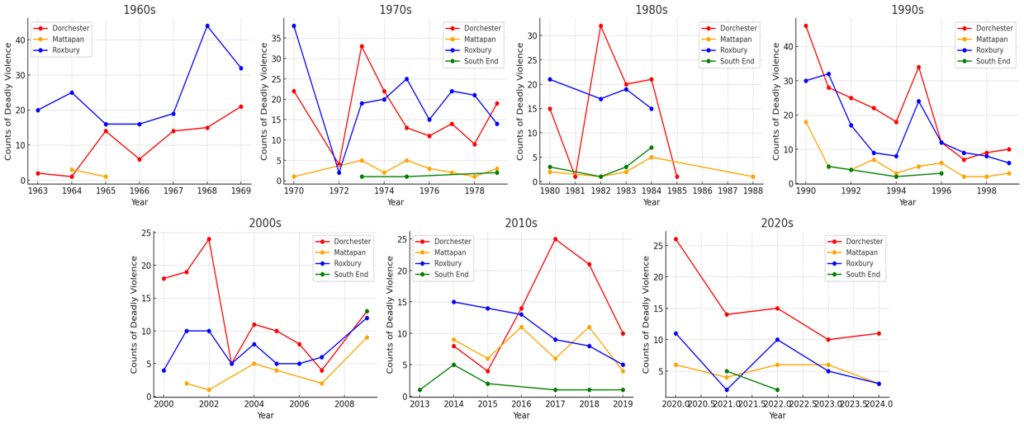
updated maps and data descriptions coming soon
Forthcoming Exhibits on Public Safety, Food Justice, & Civic Power
Explore The Empowering Descendant Communities to Unlock Democracy Project’s Jail-Based Voting Ambassadors Zine on Reimagining Democracy (September 2025)
Our zines show how people inside Suffolk County jails understand public safety, civic power, and community care in their own words and images. Building on that model, upcoming zine pages from the Storymapping, Oral History, and Unsolved Homicides groups will offer simple, visually engaging explanations of data, community stories, and local histories that connect directly to the BBC project’s three pillars. These zines are designed to be shared inside jails, youth facilities, and community spaces, giving readers clear, accessible tools to reflect on their experiences and the ongoing justice work happening across Boston.
Community storytelling on the BBC resource page will feature short, powerful oral histories from Boston residents who speak about what public safety, incarceration, and reentry look and feel like in their everyday lives. These sessions will highlight people’s experiences with harm, healing, neighborhood change, and coming home from jail or prison, offering honest reflections on what communities need to feel safe, supported, and heard. Each story will help visitors understand how public safety is shaped not just by policy, but by family, faith, food access, and the civic power people build together.
Digital storymaps and archival exhibits coming out of the student working groups will offer clear, visual ways to explore Boston’s history of public safety, food justice, and civic power. The Storymapping group is creating interactive neighborhood maps, data visualizations, and timelines that make complex information easy to understand. The Oral History group is building exhibits that weave together interviews, photos, and community memories to show how people have experienced harm, healing, and leadership across generations. The Unsolved Homicides group is developing digital exhibits that document long‑standing cases, wrongful convictions, and community efforts to seek justice. Together, these storymaps and exhibits will form an accessible digital archive that helps residents, students, and people inside jails and youth facilities see their own histories reflected and valued.
Building Beloved Communities Project Contributors
The Ohio State University (OSU) research team works alongside community collaborators in Boston through the Digital Resource Advisory Committee (DRAC), a group that meets regularly to guide the direction, accuracy, and accessibility of the Building Beloved Communities digital resource. DRAC brings together OSU faculty and students, Roxbury Community College librarians and community scholars, and leaders from organizations working in collaboration with Healing Our Land to review research findings, shape digital exhibits and storymaps, and ensure that all materials reflect the lived experiences, priorities, and expertise of Boston residents most affected by public safety, food justice, and civic power. This shared process keeps the project accountable to community knowledge and strengthens the digital resource as a tool for learning, organizing, and collective action.
OSU Research Team
DeAnza A. Cook, Assistant Professor of African American History & Leadership, The Ohio State University
Jared Grant, Assistant Professor of Agricultural, Environmental, and Development Economics, The Ohio State University
Felipe Caro López, Graduate Student Research Associate, The Ohio State University
Victor St. John, Assistant Professor of Criminology & Criminal Justice, John Glenn College of Public Affairs, The Ohio State University
OSU Student Contributors
Les Shigley (Unsolved Homicides Working Group, Spring 2026)
Ezra Chomak (Unsolved Homicides Working Group, Spring 2026)
Felipe Alberto Caro López (Storymapping Working Group, Spring 2026)
Carlye Mahler (Oral History Working Group, Spring 2026)
Charity M. Martin‑King (Oral History Working Group, Spring 2026)
Community Collaborators & Digitial Resource Advisory Committee Members
Pastor Franklin Hobbs, Executive Director & Founder, Healing Our Land, Inc.
Rachael Rollins, Executive Director of The F.O.R.T. at Roxbury Community College; former Suffolk County District Attorney and U.S. Attorney for the District of Massachusetts
Kadeem Foreman, Community‑Based Research Associate; formerly incarcerated advocate and Returning Citizens with Healing Our Land, Inc.
Ralph Holley, Librarian Archivist, Roxbury Community College
Community Partner Organizations
Louis D. Brown Peace Institute — A nationally respected healing‑centered organization that supports families impacted by homicide and works to build communities where peace is possible.
We Are Better Together — A Boston‑based nonprofit that provides healing, advocacy, and peer support for families affected by homicide, incarceration, and community violence.
Mayor’s Office of Returning Citizens Boston — A city office that helps people coming home from jail or prison reconnect with housing, employment, education, and community support.
Democracy Behind Bars Coalition — A statewide coalition led by directly impacted people working to protect and expand voting rights for incarcerated residents across Massachusetts.